This is a guest post from my friend George Mundorf whose large dollhouse collection includes many wonderful art deco dollhouses. This is his Malibu art deco house built by Schoenhut in the late 1930s...but wait, he has another house almost exactly like this one. I will let George tell you the story of his two houses....

It
was on a dark and stormy night...well, no. Actually it was on a sunny, summer
afternoon in Kutztown, Pennsylvania, that I stumbled upon an Art Deco dollhouse
in the basement of an antique shop. At the time I knew nothing about
dollhouses, much less the Schoenhut company, but I was intrigued with Art Deco
architecture and knew the actuality of owning a real Deco house was not in the
cards, but a miniature one...?
Why
not?
It
was not in the greatest shape. A couple of windows – wooden surrounds included
– were missing, as well as most of the celluloid “glass”. I got it home to
Manhattan, and spent a lot of my spare time building the window sills (a series
of flat pieces of wood put together with slits to hold the plastic “glass” and
to fit on top of, and below, the Masonite wood walls), and had the windows
replaced.
The
celluloid “glass” have brown partitions and blue blinds printed on. I don't
remember if I had them professionally made or did it myself with model tape on
clear plastic. They came out so well, I tend to think I had them done, but
can't remember.


exterior

interior
I later found out that my house was a very
hard-to-find Schoenhut dollhouse. It is a creamy yellow with orange trim and a
blue and orange striped awning over the second story patio which, fortunately,
was still attached to the house.

There is a bow window with orange roof and that luckily was in perfect shape. The bow window has blue drapes printed on the “glass”.

Also still intact, were metal grid-like doors (front and patio),
also in orange.


The orange color paint was surprisingly easy to match for the windows. The dowels holding up the awning were missing but that was an easy fix. Inside, the house is not very detailed, though the walls on the bottom floor are yellow and the second floor is in blue.

The house is electrified, and the light bulbs in the center of every one of the five rooms have surrounds which are white. All electric wires are hidden within the individual floors themselves, so are not visible.

The kitchen in the separate wing, has, along
the top and bottom of the right wall (from the back), two strips of wood,
painted white. Illustrated in black, the boards have four pair of inoperative
cabinet doors (two on top, two on bottom) and two burners for a stove and small
(perfectly flat) sink. You have to provide your own refrigerator.

There are two
arched doorways – no doors – between the rooms and a squared off door leading
into the kitchen wing.

There is a bow window with orange roof and that luckily was in perfect shape. The bow window has blue drapes printed on the “glass”.


Front door

Patio door
The orange color paint was surprisingly easy to match for the windows. The dowels holding up the awning were missing but that was an easy fix. Inside, the house is not very detailed, though the walls on the bottom floor are yellow and the second floor is in blue.

The house is electrified, and the light bulbs in the center of every one of the five rooms have surrounds which are white. All electric wires are hidden within the individual floors themselves, so are not visible.


The
floors are brown, the color, I believe of the original Masonite. The house is
on a green textured base which is trimmed in green painted wood.


right side of house
Schoenhut
made three Art Deco dollhouses in 1937. My house was the mid-priced “Malibu”.
The most expensive (and very impressive) house was the “Beverly Hills” and the
least expensive was the “Long Beach.” While the Beverly Hills is extremely
rare, ironically the cheapest one is rarer still. No one I know has ever seen
one in person.


The
rarity of the Schoenhut Deco houses – and really, all Deco houses made by other
manufacturer's (for example Rich Toys, Tri-Ang, J.J. Anthony, Built-Rite) –
might be accounted for by the Depression and the extreme nature of the design.
Little girls may not have wanted to receive, nor play with, such an odd, untraditional
house. Then, as now, other designs – Colonial, Plantation, Tudor – were more
acceptable. Art Deco houses weren't common in real life either!
Without
going into too much detail, Art Deco started out as a highly decorated, and
expensive style made for the rich and truly Avant-Garde. Buildings were of the
skyscraper type, with minarets and bold facades with stair-step levels. Real
Deco houses from this period are so rare as to be non-existent.
With
the coming of the Depression, the design took a non-decorative, simpler,
streamlined approach which was easily massed-produced and inexpensive.
Manufactures of practically everything could produce new and seemingly
up-to-the-minute products by eliminating costly decoration. It is this period,
from about 1930 to 1940, that the Art Deco (also called “Moderne”) architecture
affecting real homes and the subsequent dollhouses that is relevant to the
Schoenhut dollhouse.
What
makes a dollhouse “Deco”? First of all, it must have a flat roof. I can't
conceive of a Deco dollhouse with anything but a flat roof, but a flat roof
alone does not make an Art Deco dollhouse – a fact not acknowledged by many
eBay sellers. {And remember, Art Deco is not Art Nouveau!}
The
Schoenhut house has the following Deco characteristics:
1.
Simple geometric shapes. In this case, the house appears like two boxes, one
square and one rectangular, put together. There are no towers, dormers,
wrap-around front porches, cone-shaped roofs.

2.
There is little decoration. There are no shutters, window boxes, attached to
the wall sundials, half-timbers, gingerbread. This is one serious house!
3.
There is a second story patio.


4.
The emphasis is on the horizontal – note the extra long windows. No Gothic and
Victorian “reaching for the heavens.” The earlier deco skyscraper vertical
influences are now in the past.

5.
The color scheme: blue and orange is hardly traditional for a house – but the
World's Fair of 1939 used those same colors as part of its design. We tend to
think of Art Deco in terms of white and pastels. Not necessarily true – a very
Deco house in Florida was navy blue.


6.
The use of Venetian Blinds as a visual design element. The blinds emphasize
the horizontal and also are reminders of “speed lines”. (Think of a cartoon
speeding car with the lines trailing the car indicating speed – another Deco
characteristic).


Interior lighting
Other Deco architectural detail found on other dollhouses from this period are circular windows, an exterior staircase, a series of parallel horizontal lines (those “race” lines yet again!) used somewhere on the house, “eyebrows” over windows or doors (little, basically useless shelf-like protrusions), glass brick, and windows meeting at the corners of the house.
So
I was very content with my Malibu – and then my Beverly Hills – Deco Schoenhut
houses, always keeping an eye open for the elusive Long Beach. That is, until I
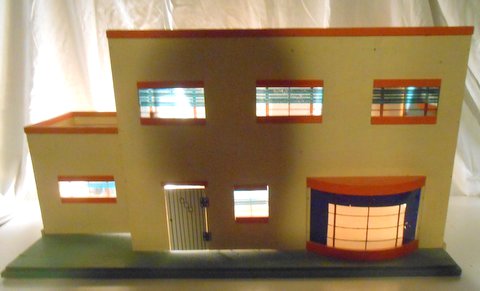
stumbled onto a dollhouse on eBay that was a twin – well almost – to my first
Deco Schoenhut.

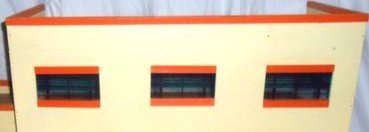
It had the same colors, same shape, same windows with painted blinds, same base, same patio, same configuration – little window by the front door, bow window at one end of the house …but wait, something was strange. It was bigger. There was an extra window on the second floor, it had no strange little chimney poking up one side of the roof, there was no awning (and apparently never had one), and most glaringly, the doors were different. Unlike the Malibu, which has a Schoenhut label in the middle of the rear base surround, this house is unmarked.

same patio, different door
and no awning

different front door

three windows instead of two
But money was low that month – for me, not an unusual event – and my dollhouse cohort, Patty Cooper, after some discussion, bought it. Out of sight, out of mind and I knew I could always get my secondhand pleasure discussing the house with Patty. Years passed and another one showed up on eBay – and yes, I snapped it up.

This
house, too, had problems – the same problems as the other house, I might add.
The “glass” was missing from most of the windows, as were about six window
sills. Worse, the front door was missing. But now I had Patty's door to use as
a model as it is completely different from the Malibu. A friend made all the
sills, another made the “glass” and front door. The house is now restored.
Well, almost.


upper level interior doors

lower level interior doors
The
house is electrified too –
-but differently from the Malibu. The wires are tucked in the back interior of the house, hidden behind the over-hanging “borders” of each floor's ceiling and would be invisible to the viewer.

-but differently from the Malibu. The wires are tucked in the back interior of the house, hidden behind the over-hanging “borders” of each floor's ceiling and would be invisible to the viewer.
 |


The lights – which seem original, and Patty's are the same – are colored Christmas tree lights which is strange as it would shine a different colored hue over each room. I will not try to replace the ragged wiring.
Now
for particulars:
MALIBU TWIN HOUSE
Size:
|
Size:
|
29¼” W x 14½”
D x
15½ H
(the chimney would add 1½” more to the height)
 |
33” W x 14¼” D x 17” H
 |
Front Door:
|
Front Door:
|
Orange metal grid with no
“glass” behind openings. On right of house.
 |
White door with brown
articulated vertical lines indicating wooden planks and illustrated (solid,
no glass) windows on the diagonal. The door is rather Colonial in style
rather than Art Deco. On left side of house.
 |
Patio Door:
|
Patio Door:
|
Orange metal grid with no
“glass” behind openings.
 |
White Dutch door more
suitable for a Ranch house than an Art Deco. The windows are drawn on; 3 rows of 3 black
squares. The door opens but not like a
true Dutch door.
 |
Chimney:
|
Chimney:
|
Yes.
 |
No.
 |
Windows:
|
Windows:
|
Two on second floor. Small window by door is 2” x 3”.
  |
Three on second floor.
Small window by door is 2½” x 3¼” –
noticeably larger.
  |
Roof:
|
Roof:
|
Brown. The roof and the
second floor ceiling are hollow in places to accommodate electric wires. The roof is totally
surrounded by a low wall.
 |
White. Not having to have
wires within, the roof and second floor are solid, substantial and noticeably
heavier. The roof only has a low wall on three sides.
 |
Floors:
|
Floors:
|
Brown Masonite
 |
Stained plywood
 |
Rooms:
|
Rooms:
|
Three on bottom floor. Two
on top floor.
 |
Three on bottom floor.
Three on top floor.
 |
Interior:
|
Interior:
|
Yellow painted walls on
bottom floor. Blue painted walls on top floor. Arched doorways between main
house rooms. Squared off door into kitchen. Electric wires hidden within roof
and second floor ceiling.
 |
Yellow painted walls on
bottom floor. Blue painted walls on top floor. All doorways are squared off
except one arched on the main floor in the middle of the house. Electric
wires exposed but shielded by wooden trim.
  |
Kitchen:
|
Kitchen:
|
Parallel white boards along
top and bottom of right wall, printed
with 4 pair of cabinet doors, plus a 2 burner stove and small flat sink.
  |
No cabinets or appliances provided.
 |
The twin house was shown in an ad put out by FAO Schwarz, a major toy store headquartered in New York City. (FYI: the flagship store on 5th Avenue is now closed.) I don't know if the ad came from a catalog, a trade publication or another source. It is called a "Modern Dollhouse."

But here's the mystery: It seems apparent that Schoenhut made the Twin House--but maybe not. Did FAO Schwarz want a dollhouse that it could offer as an "exclusive" ("Only at FAO Schwarz!") and have Schoenhut make the house for them? Did Schoenhut take on private commissions? Or did FAO Schwarz have it copied from the Schoenhut house with just enough differences to avoid a law suit? The Art Deco dollhouse world wants to know!
....George Mundorf
Post Script: Thank you, George, for allowing me to post this on my blog and share the wonderful information with readers.
I knew about the Schoenhut Malibu dollhouse from seeing pictures of it on Ebay, in my copy of a 1937 FAO Schwarz Christmas catalog, and in Dian Zillner's American Dollhouses and Furniture From the 20th Century, page 25; but, until talking with George, I did not realize there was a Malibu "twin house".
Patty Cooper has shared more information about the Art Deco dollhouses made in the late 1930s and carrying the trademark Schoenhut metal tag. According to an old article in Antique Week, the 3 Art Deco dollhouses were made by a spin-off company called Schoenhut Manufacturing Co., organized by the original founder Albert Schoenhut's son Albert and grandson Frederick. They published catalogs in 1937 and 1939 that advertised "a large selection of dollhouses including most of the parent company models plus several new ones in an Art Deco International style. These 'streamlined' models featured curved windows, balconies, and flat roofs."


