Thursday, August 30, 2018

Schoenhut Neighbors


Emma and Granger Page are eager to meet
 their new neighbors  Ranya and Sanjay Chowdhury, 
who recently immigrated to the United States 
from his native country of India. 
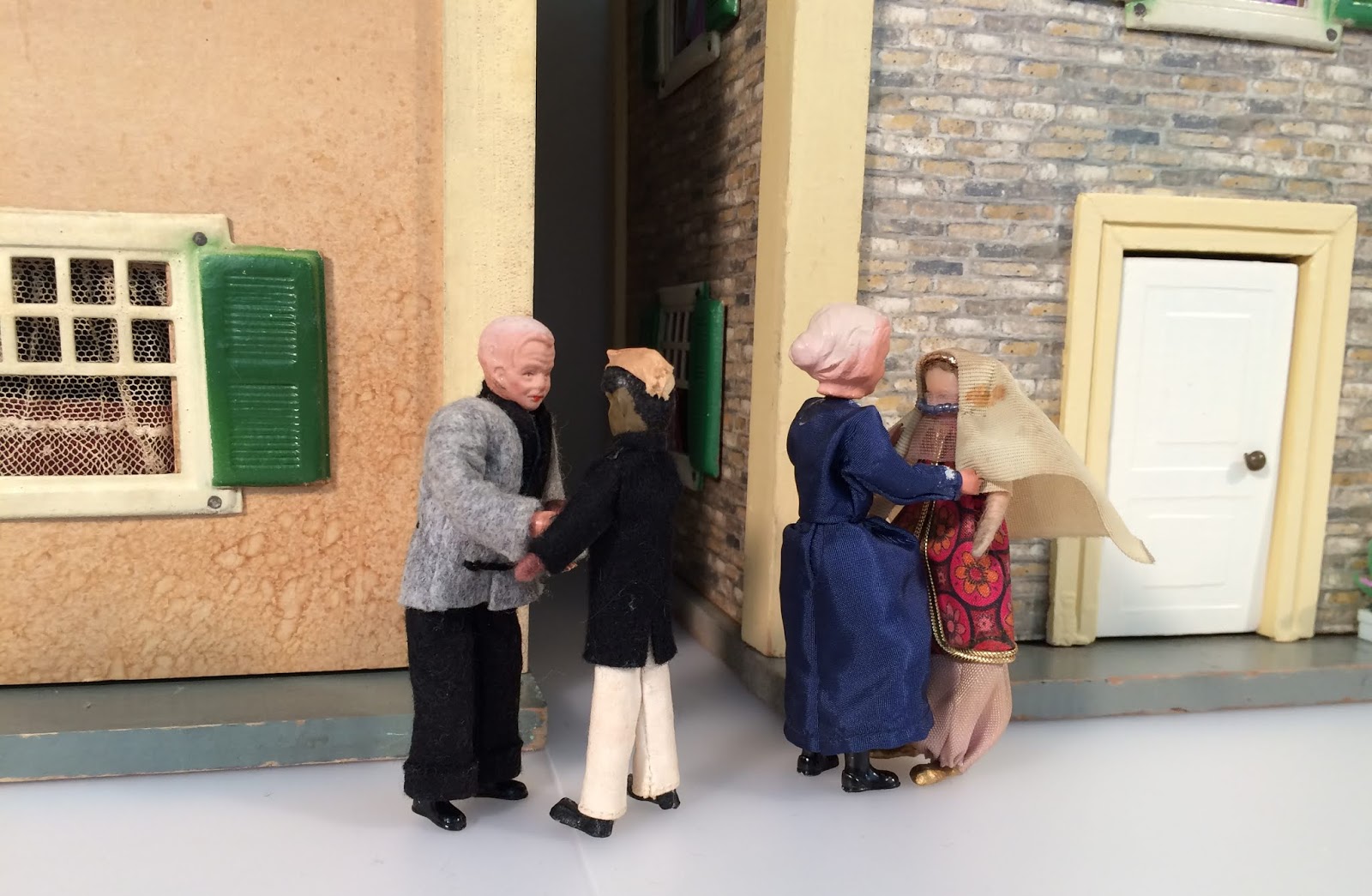

Emma and Granger introduce themselves to Sanjay and Ranya
 and invite them to visit their home.


While Ranya admires the fresh flowers Emma just picked 
from her garden, and Sanjay and Granger discuss 
whatever it is men discuss when they get together....
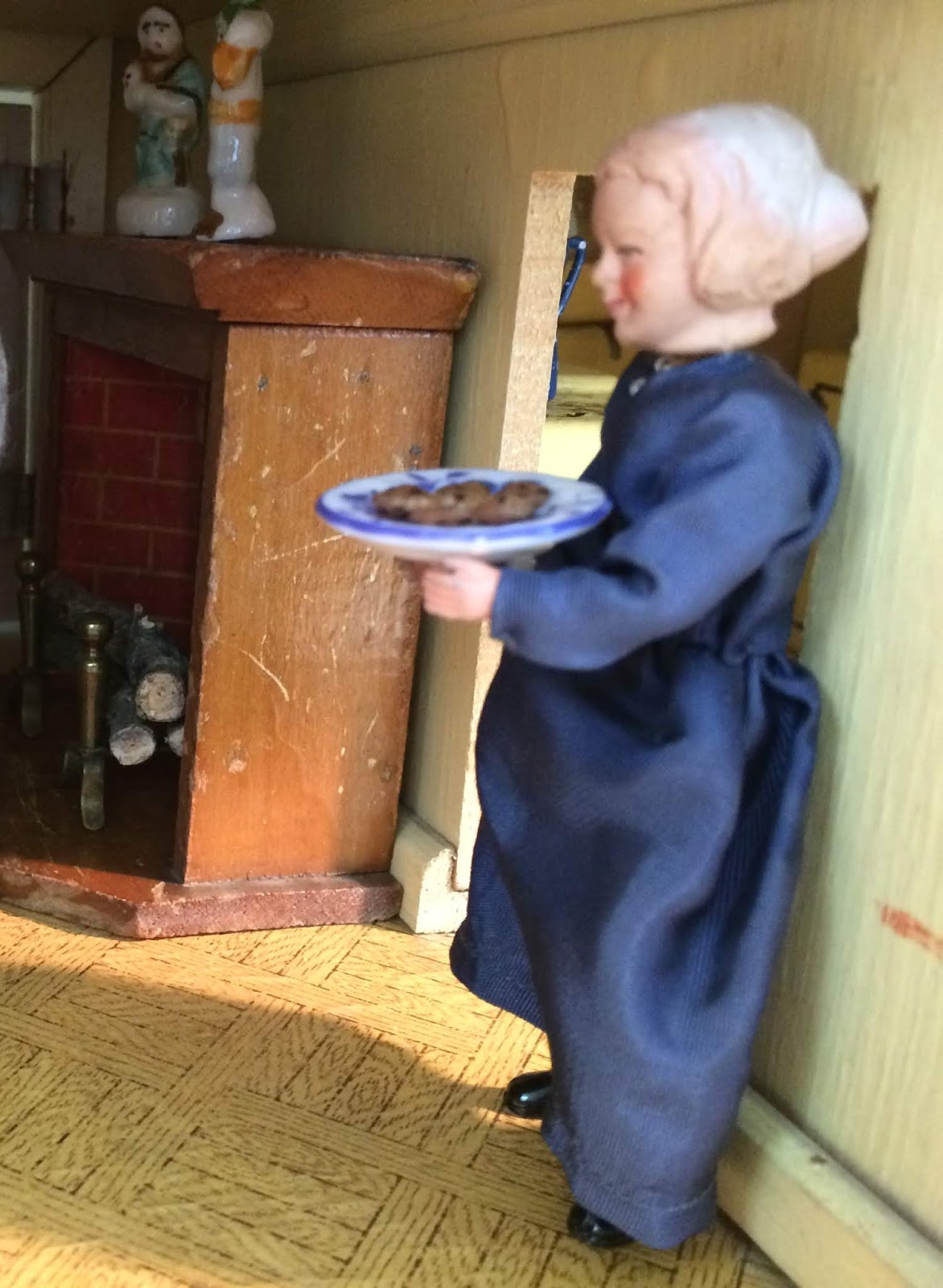

...Emma brings freshly baked cookies from the kitchen. 
Ok, that's the story. Let's get on with learning 
about the Schoenhut dollhouses and the furniture.


These two houses are the smallest of my six Schoenhut dollhouses. I can blame this particular collection of houses on Carol Morehead for suggesting I get a Schoenhut dollhouse for my Schoenhut dollhouse furniture when I posted about it back in 2010. Both of these houses were made between 1931-1934, and are from the Schoenhut inexpensive line of heavy cardboard dollhouses with plastic windows, wooden floors and wooden support beams. 
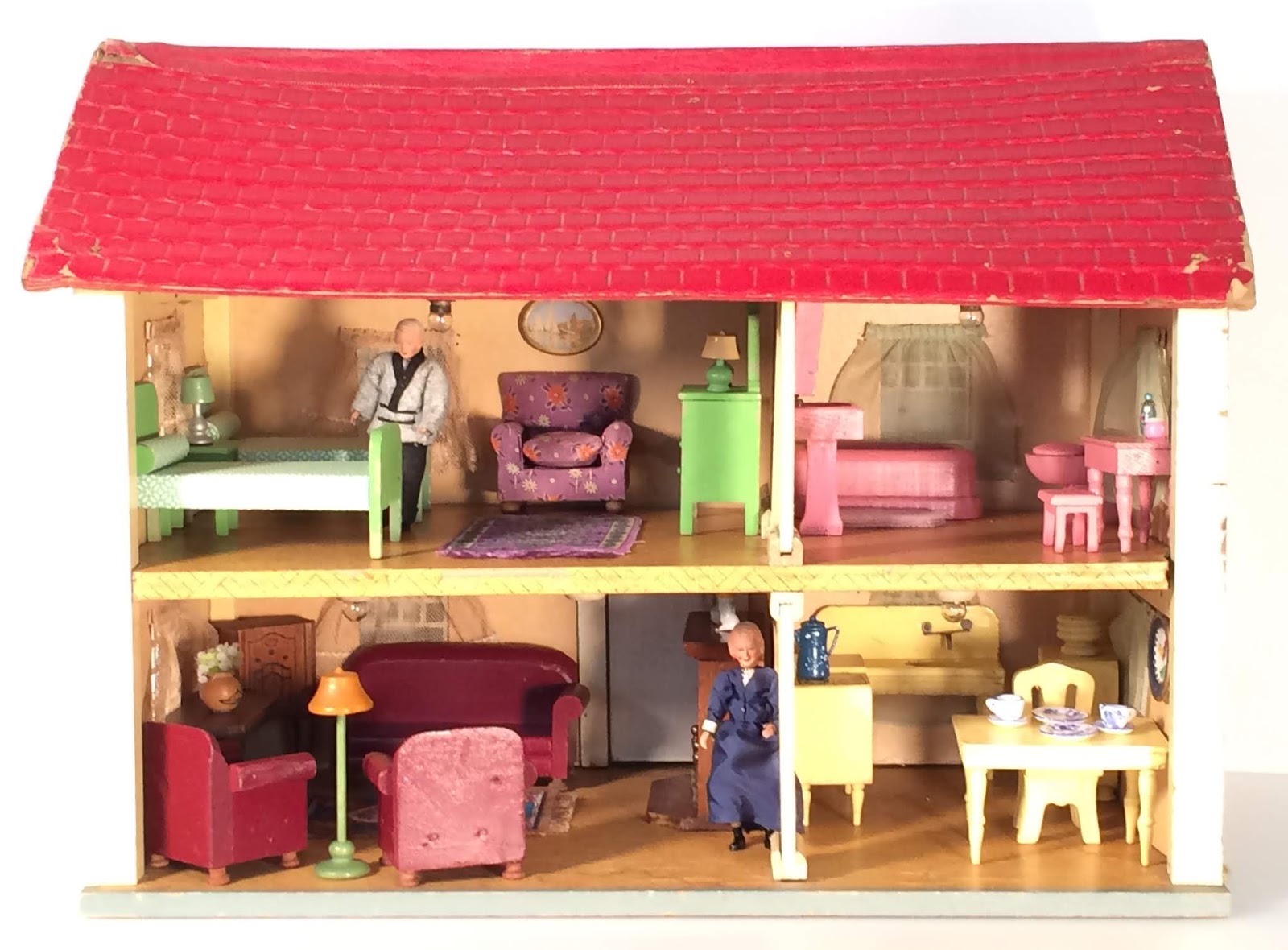


This house, with the centered front door and four rooms,
 measures 17½” x 10½” x13½”. 
It has the original curtains that came with it. 


This house was originally electrified, but the equipment is no longer 
in working order. That will happen when you cut the electrical cord. 


The living room furniture - chairs, sofa and library table - are from set 6/1 of Schoenhut's 1931 line of dollhouse furniture. The fireplace was part of the Apartment House Rooms set 5/29F Living Room introduced in 1930. 
The radio, missing the top board, was part of the set 6/21 Living Roon 
introduced in 1933.French fèves decorate the mantle.  
Not sure how that Strombecker lamp was included...I don't drink during the day. 


I have only one chair matching this pale yellow set....
that certainly means that Granger must stand when having meals.


The kitchen set, 6/523, was a new design produced 
by Schoenhut in 1933. Schoenhut described it as "canary". 


The light fixture hangs low enough that Granger 
sometimes bangs his head on it in the middle of the night.


This is Set 154 Bathroom from the 1934 Schoenhut line.


Granger is trying to remember why he came to the bedroom. 
That happens often as one ages. Or drinks. 


The twin beds and bedside table are from set 6/5 Bedroom line produced in 1931, 
while the dresser is from set 6/5 Bedroom line produced in 1932.  
The paper used to resemble bed covers was missing and has been replaced.
The chair is a Kage product and all lamps are Strombecker.   
   

All the curtains came with the house. They were originally pleated, 
but then I laundered them and now they are not.


Granger and Emma Page are German Caco dolls from the 1950-60s.


This slightly smaller Schoenhut dollhouse measures 16” x 9½” x 13” 
with a front door situated to the side. It also contains four rooms. 


This is how it looked when I purchased it from Ebay. 
It is evident that it had paper attached...most likely in a brick design. 
It has taken me several years to decide how I wanted to restore it. 
I chose this paper from Itsy Bitsy Mini thinking it would go with 
the red roof and green shutters. Well it didn't. 
So I ended up painting the roof green. 
I also wallpapered the interior to cover the stains from many years of play. 


I found this picture of a Schoenhut house on Ebay several years ago.  
I think my house must have looked similar when new. 


Four rooms decorated as bedroom, bath, living room 
and kitchen dining room combo. 


I've furnished this house with Jaymar Specialty Company Happy Hour dollhouse furniture circa 1933. Jaymar was associated with the toymaker Louis Marx and Company. Five rooms of this furniture were produced in a ¾” to 1’ scale
 with an Art Deco look. 


 In red and black, simple lines and no moving parts....
included were sofa, chairs, end tables, lamps,


 library table, grandfather clock and a floor lamp. 
Orange and red and black...nice combo. 


I've combined the kitchen and dining room furniture and hung the curtain crooked.

The kitchen included a stove with top oven, a two-legged sink, a hutch, a kitchen table and one chair in a bright yellow with black trim. 
A carpet sweeper was included with the kitchen set.


The dining room came in green with black designs that included a dining room table made in the same style as the library table, a buffet, and four chairs. 
A pair of black candle holders with orange candles were part of the original set.


Notice that the Happy Hour furniture is the perfect size for this small house!


The bedroom furniture includes twin beds, a bed side table and a dresser. 
Also included, but not with my set, was an orange and green table lamp 
and a pair of orange and black candle sticks. 


All of the curtains in this house were printed on colored index paper. I included an extra dresser and dining room chair for the lady of the house to use as a vanity.


My bathroom collection contains the necessary pieces. 
Jaymar also included a bathroom stool and two towel bars. 
The commode lid lifts...so there is a moving part to the Jaymar collection!


Ranya and Sanjay  Chowdhury are Dol-Toi dolls in national dress made in United Kingdom in 1960. These dolls came to me as a pair but representing different countries. And now they have immigrated to America....and are accepted and welcomed in my Dollhouse Village!

All the information on the Schoenhut dollhouse furniture comes from 
Schoenhut Dollhouse Furniture 1928-1934 by Patty Cooper. 
It can be found on the Blurb.com website in softcover or instant PDF version. 


Information on the Jaymar Specialty Happy Hour furniture was found in 
Antique & Collectible Dollhouses and Their Furniture
by Dian Zillner and Patty Cooper.

Tuesday, August 21, 2018

Wren Cottage Weekend

Chip and Birdie Wren are on the way to their weekend cottage 
with their twins Pip and Pippa. 

Their cottage is appropriately named.

 The first thing Pip and Pippa do is rush to their swings that 
dad set up on their last visit to the cottage.  
While the kids swing, Birdie and Chip relax on the patio. 

Birdie suggests they invite their close neighbors, 
the Lapins, over for a cook-out that evening. 
Chip thinks that is a great idea,
 as the Lapins are good company. 

Bunny and Peter Lapin arrive with 
a large bottle of his homemade elderberry wine. 
Amazingly, they have no children.


Peter uncorks the wine while Chip fires up the grill.

 Peter silently hopes that is not one of his relatives Chip is grilling. 

The adults are having an enjoyable evening....

 but where are Pip and Pippa?

 They are not in the family area.

Or the kitchen....


or their parent's bedroom.


 Surprise! Not hiding in the water closet either!

Oh here they are! Practicing gymnastics on their bunk beds.
Did you notice that Pip can bend his knees forward? 
That's the photographer's fault.


 After dinner, when the Lapins have gone back to their rabbit hole, Pip and Pippa join mom and dad on the patio. Mom and dad are still putting away the juice while Pippa continues to  practices her balancing act and Pip pretends he is a statue. 


 This dollhouse is in two parts. 


It does not show signs of ever being attached.


It was sold by the F.A.O. Schwarz Toy store 
in their Christmas catalog in 1960-61. 
I'm quite sure it was a German import. 


Most of the furniture is marked West Germany. 
 The side table above and the 2 red stools are Lundby.


 The beds are West German, with the bunk bed being similar 
to the original furniture sold with this weekend house.

In order....Dol Toi, Lundby, West German. 

The grill is marked Japan. The chairs are not marked, 
but are just the right size for my little family.


Pip, Birdie, Chip and Pippa Wren...
German Caco dolls measuring 2¼-4" tall.

 Bunny and Peter Lapin are Kunstlerschutz ornaments 
made in Germany.  At 4" tall to the top of their ears, 
they make great dollhouse dolls.


A special thanks to George Mundorf for sharing 
pictures of his weekend cottage so I was
able to copy the front sliding doors!

Thursday, August 2, 2018

Help save Dolls' Houses Past and Present e-zine


"Dolls' Houses Past and Present (DHPP) began in 2009 as an online meeting place for owners and collectors, conservationists and restorers of both old....and new dolls houses......From that very small beginning, it has grown considerably and is now an internationally significant collaborative information site which:
  • is referenced by museums and sellers of antique and vintage dolls houses
  • researches and documents dolls house makers of all periods,....in production in the USA, the UK, Germany, Sweden and other countries 
  • has a Photo Gallery with over 38,000 photos in over 2500 photo albums, uploaded by individual members
  • holds detailed photographic databases of dolls houses made by the famous UK firms G & J Lines and Lines Bros Triang, Vol. 1: 1919-30, Vol. 2: 1930-41, and Vol. 3: 1946-71
  • lists over 165 dolls house makers as Categories in the Photo Gallery, aiding recognition and identification of their dolls houses
  • has 30 back issues (click on any issue to view contents) of the e-zine...., which publishes original research, presents rare antique dolls houses, and shares members’ collections and original creations
  • has Discussion Forums with over 32,000 posts by members in over 2500 topics, which are particularly important for enabling members to get help identifying and restoring their dolls houses. There are nearly 1200 members worldwide, many of whom gladly share their expertise in identifying makers, restoration, or finding materials and miniatures....."

"Dolls Houses Past & Present is not a business, so has no income. Membership is required to be able to post on site, but joining is free. The site is not monetized and carries no external advertising."

"Dolls houses can be culturally significant, adding to social history by perfectly preserving, in miniature, homes of a given period in time. Queen Mary's early1920s dolls house at Windsor Castle in the UK is one well-known example, but by no means are all royal residences! Many examples of much more humble homes exist, and a great number are represented in the Dolls Houses Past & Present photo albums."

"The site is now in crisis, because the structure of the website itself is failing. The web host used since the beginning no longer supports the site. The alternative site builder that was offered by the current host is not compatible with the sites needs. DHPP has only recently learned that the host does not hold back up of DHPP files, neither can it access DHPP data by any file transfer protocol, so there is a very real danger that the unique archives may soon be lost.  DHPP is now faced with the need to raise £10,000 for a new website to be developed urgently to its specification."

"Please, if you are able to help Dolls Houses Past & Present, any contribution, no matter how small, will be very gratefully received. We recognize that this is not a life or death cause, and it may affect only a small number of people, but this unique specialist archive once destroyed would be very difficult, if not impossible, to restore."

Because of copyright rules, I wasn't able to share pictures from this e-zine, but I have added many links to different information shared from the many issues already published. Please check them out, but know that there is so much more information that has been shared by members....from restoration helps and making dollhouse furniture and food, to the history of so many different dollhouse makers from the 19th and 20th centuries. 

As stated earlier, DHPP is not a business...it has no income, membership is free, and the site has no external advertising. Rebecca Green, site owner and editor of DHPP, and her group of administrators give freely of their time to produce and run this website and they would like DHPP to remain with free website access to all. 


You can donate by clicking on the following link:  FUNDRAZR

Things to know before you donate...
 →FundRazr hosts small campaigns like this one for free, but does ask for a voluntary contribution from donors. The extra contribution towards FundRazr's running costs is voluntary, and contributors can opt out. To do so, set the amount to £0.
→You do not have to open a FundRazr account in order to contribute a donation. 
→Donation amount is shown in British pounds. As a rough guide, against a few major currencies, £1 today (8-2-2018) is worth €1.12, US $1.30, Can $1.70, Aus $1.77...obviously, these values fluctuate daily. Paypal can be adjusted to send in another currency or to show the PayPal conversion rate. Paypal Help has full details.

No matter how large or small, every single donation will help to save a truly wonderful dollhouse website. Please help if you can....and many thanks!